From Research to Startup: Lessons from OrganOx
Scritto da Redazione Radio Bocconi il 25 Novembre 2026
Constantin Coussios’s story shows how a practical problem can be turned into a business that makes a tangible difference to people’s lives. The journey recounted by OrganOx’s co-founder also shows that financial success is not the starting point: at the heart of it are time, human relationships and the ability to take an idea out of the lab, even when doing so requires years of personal commitment.
When an organ is donated for transplantation, time is crucial. Traditional cold storage slows deterioration, but preservation time remains limited, and some donor livers do not tolerate it well. Coussios recalled that organs were transported in cool boxes.
OrganOx’s story began with this practical problem. The company was founded in 2008 as a University of Oxford spin-out by Greek biomedical engineer Constantin Coussios and transplant surgeon Peter Friend.
On 16 November 2026, Coussios spoke about his journey at Palazzo dei Giureconsulti in Milan during a TEF Talks event, offering a glimpse into the decisions that shaped his entrepreneurial story.
Creativity and complementary skills
The idea behind OrganOx was to preserve donor livers under conditions closer to those inside the human body. Its metra device circulates an oxygenated, blood-based fluid through the liver at approximately body temperature, extending preservation time while allowing clinicians to assess the organ’s function before transplantation.
The idea emerged in an academic setting by combining Coussios’s engineering expertise with Friend’s clinical expertise.
This complementarity matters: bringing together different professional skills can support startup growth.
Moreover, a working paper published in the U.S. Census Bureau’s research series found an association between greater diversity in early team members’ previous industry experience and faster growth. An increase of one standard deviation in the study’s diversity measure was associated with increases in five-year employment and sales growth equivalent to 16% and 10% of their respective sample averages.
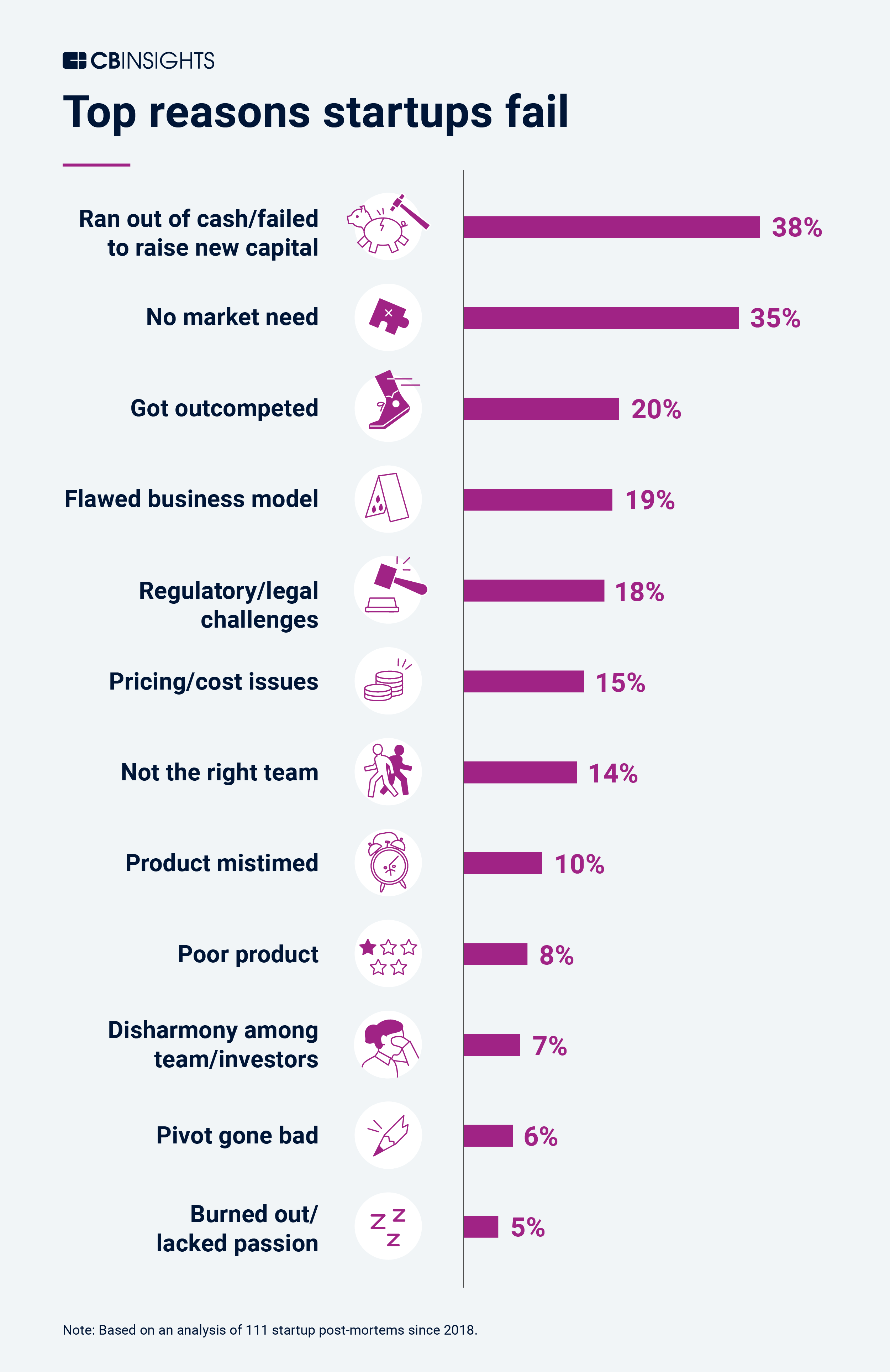
At the same time, in CB Insights’ 2021 analysis of 111 startup post-mortems, 14% cited not having the right team as a contributing factor in their failure. The report highlighted problems including missing expertise and difficulties recruiting key employees.
The implication is that, although human relationships are vitally important within a founding team, a close friendship should not be the deciding factor in choosing a co-founder. Indeed, in Noam Wasserman’s research on technology and life sciences startups, teams formed through prior social relationships were more likely to lose a founder than those formed through prior professional relationships.
Wasserman also cites a 1989 study in which venture capitalists identified ineffective senior management as the main contributing factor in about 65% of 96 troubled portfolio companies. Although this finding concerns a specific historical sample, it illustrates the importance investors attach to the people running a business.
Emotional closeness can make people reluctant to discuss roles, equity and performance, creating tensions as the company grows. Previous experience of working together can help potential co-founders assess their professional compatibility before committing to a business.
For Coussios, the relationship with a co-founder is one of the most important in a company’s life: founding a company means facing difficult decisions and periods of uncertainty together.
Time and people
In Coussios’s account, financial value follows from creating meaningful impact. Money is indeed important: a startup needs resources to grow and reach the market. But it is not the only factor to consider. Coussios described time as a crucial resource, because waiting for perfect conditions can mean missing an opportunity.
OrganOx was founded in 2008, during the financial crisis. According to Coussios, securing the initial investment required the founders to accept demanding terms and a substantial dilution of their ownership.
Coussios said he did not regret that decision: in his view, the founders’ most valuable resource is not necessarily the equity they retain, but time, because an opportunity may no longer be available a few years later.
From product to impact
To assess a startup, it is not enough to describe what it produces. We also need to ask what change it brings about. In OrganOx’s case, the output is a device for liver preservation and perfusion. Its outcomes include the ability to assess liver function before transplantation and greater flexibility in scheduling transplant surgery.
During the event, Coussios explained that longer preservation times had allowed hospitals to plan transplants more effectively. This flexibility can reduce the need to perform operations in the middle of the night or at weekends, with consequences for how surgical teams organise their work.
Coussios also described organisational effects that the founders had not anticipated. He recalled, for example, a surgeon who, thanks to better scheduling, was able to spend more time with his family. The technology therefore did not just change the way donor livers were preserved: it also affected working routines and the organisation of care.
When scepticism meets adoption
OrganOx’s story is also a reflection on how new ideas are received. Coussios recalled that the technology initially met with scepticism; later, he noted, organ perfusion became a major topic at transplant conferences.
This is a useful dynamic to consider for anyone who wants to start a business: the market may not immediately recognise the value of a solution, especially if it introduces a different way of working. But this does not mean that objections should be ignored. Rather, it means listening to them, gathering evidence and continuing to check that the product meets a real need.
Coussios’s story shows that seizing an opportunity means more than having an idea. It means finding a problem worth tackling, building a team capable of addressing it and guiding the solution through a journey that is often longer and more complex than expected. And when the technology proves its value, even those who initially doubted it may end up using it.
Pierfrancesco Borelli
Fonti: University of Oxford — OrganOx, Companies House, TEF Talks — evento, Nature — studio sulla conservazione normotermica, U.S. Census Bureau — studio sulla diversità delle competenze, CB Insights — report 2021, CB Insights — grafico originale, Stanford eCorner — Noam Wasserman, University of British Columbia — intervista a Wasserman, Gorman e Sahlman — What Do Venture Capitalists Do?, Saïd Business School — intervento di Coussios, Ingenia — intervista a Coussios.